Spring Home Maintenance Checklist: 14 Tasks That Pay for Themselves
Spring home maintenance checklist with sourced cost-of-neglect data for every task: gutters, AC tune-up, roof, dryer vent, and more. Free planner included.
By the Real Estate Ledger Team
Last updated: May 2026
A skipped spring home maintenance checklist is the single most expensive thing most homeowners do every year, and almost none of them know it. The Insurance Institute for Business and Home Safety has documented that roughly nine out of ten homes show signs of water damage, and most of that damage starts with one of the spring tasks below: clogged gutters, a cracked foundation seam, or a roof flashing that wintered badly. According to the International Association of Certified Home Inspectors (InterNACHI), the average homeowner who defers seasonal maintenance for five years spends three to five times more on eventual repairs than the homeowner who runs through a spring home maintenance to do list every April.
This spring home maintenance guide walks through every task worth doing this season, what it costs to skip, and how long it actually takes. Each task is keyed to a deep-link in the Real Estate Ledger maintenance planner so you can mark it done in one tap and the app remembers when you did it next year. If you only have one weekend, do the first six. If you have two, do them all.
The order matters. We sequenced these tasks so water-shedding systems (gutters, roof, grading) get checked before you spend money on the cosmetic stuff, and so anything inspection-required is handled while contractor calendars are still open.
The Spring Home Maintenance Checklist (Ranked by Cost-of-Neglect)
These are the spring home maintenance tasks ranked by how much money you lose if you skip them. The dollar figures are based on national service-call averages from InterNACHI, the National Roofing Contractors Association (NRCA), and the National Association of Home Builders (NAHB) 2025 cost data.
| # | Task | Time | DIY or Pro | Cost If Done | Cost If Skipped (5 yrs) | Planner Link |
|---|---|---|---|---|---|---|
| 1 | Clean gutters and downspouts | 2 hrs | DIY | $0–$200 | $4,000–$15,000 (foundation, fascia) | Plan it → |
| 2 | Inspect roof and flashing | 1 hr | DIY/Pro | $0–$350 | $8,000–$30,000 (full reroof) | Plan it → |
| 3 | Service the AC before first hot day | 1 hr | Pro | $90–$180 | $3,800–$8,000 (compressor) | Plan it → |
| 4 | Check foundation grading and seal cracks | 1 hr | DIY | $20–$80 | $5,000–$25,000 (foundation repair) | Plan it → |
| 5 | Test sump pump | 15 min | DIY | $0 | $2,500–$10,000 (basement flood) | Plan it → |
| 6 | Clean dryer vent | 30 min | DIY/Pro | $0–$160 | Up to total loss (fire) | Plan it → |
| 7 | Re-caulk windows and exterior penetrations | 2 hrs | DIY | $30 | $1,200–$3,500 (water intrusion, energy) | Plan it → |
| 8 | Inspect siding, paint, and trim | 1 hr | DIY | $0 | $2,000–$8,000 (rot, pest entry) | Plan it → |
| 9 | Service the lawn mower / outdoor equipment | 30 min | DIY | $40 | $300–$900 (replacement) | Plan it → |
| 10 | Test smoke and CO detectors, replace batteries | 15 min | DIY | $20 | Life safety + insurance claim risk | Plan it → |
| 11 | Flush water heater | 45 min | DIY | $0 | $900–$2,200 (early replacement) | Plan it → |
| 12 | Inspect deck, railings, and fasteners | 30 min | DIY | $0–$50 | Liability + $1,500–$6,000 rebuild | Plan it → |
| 13 | Clean refrigerator coils | 15 min | DIY | $0 | $300–$1,800 (early replacement) | Plan it → |
| 14 | Check trees for storm-damaged limbs | 30 min | DIY/Arborist | $0–$400 | $3,000–$25,000 (storm damage to home) | Plan it → |
Water-Shedding Systems Come First
Every dollar of spring maintenance has the highest return when it keeps water out of your house. These four tasks come first because nothing else you do this year matters if water is running into your basement or under your shingles.
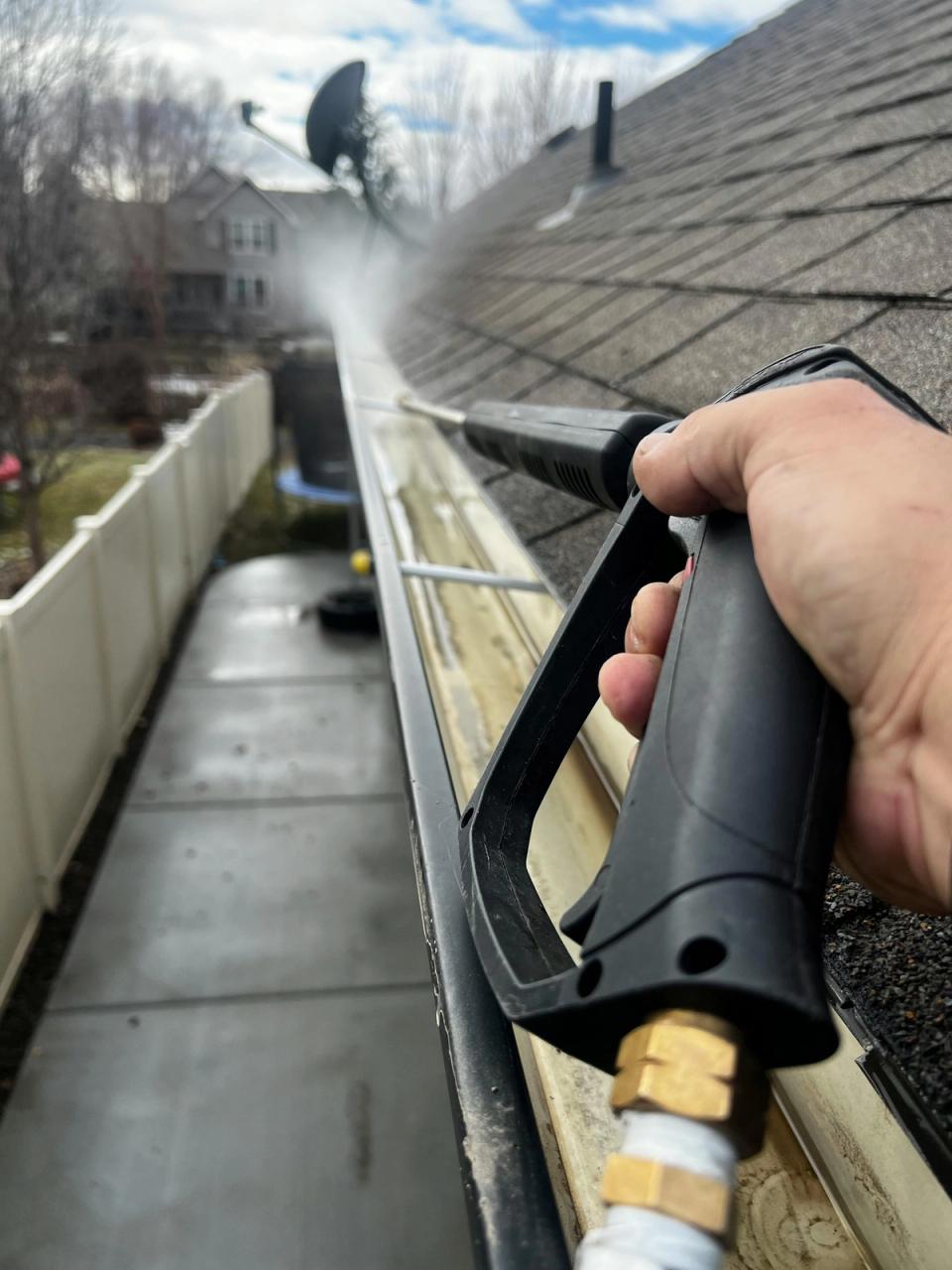
1. Clean gutters and downspouts. Winter ice and early-spring blossom drop are the two worst things for gutters. The National Roofing Contractors Association notes that overflowing gutters are one of the leading sources of foundation damage and fascia rot in residential structures. Run water from a hose down the system; if it backs up, the elbow at the downspout is usually the culprit. Add downspout extenders so water exits at least four feet from the foundation.
2. Inspect the roof and flashing. Walk the perimeter and look up. You're checking for lifted shingles, missing granules collecting at the base of downspouts, cracked pipe-boot seals, and rust on flashing. The International Association of Certified Home Inspectors (InterNACHI) recommends a visual roof inspection twice a year — spring and fall. If you see anything questionable, call a roofer in April. By June their calendars are booked through August and the price goes up.
3. Check foundation grading and seal cracks. Walk around the house with a level or just your eye. The ground should slope away from the foundation at roughly six inches over the first ten feet. Hairline cracks under 1/8 inch can be filled with polyurethane caulk. Anything wider, anything horizontal, or anything that has shifted gets a structural engineer.
4. Test the sump pump. Pour five gallons of water into the pit. The pump should kick on within seconds, run for 10 to 30 seconds, and shut off. If it doesn't, replace it now; sump pumps fail at the worst possible moment, which is the first heavy spring rain. A new pump is $150 to $300. According to the Insurance Information Institute, the average homeowners insurance claim for water damage and freezing runs roughly $13,000, and even minor basement flooding routinely produces $4,000–$5,000 in cleanup and content losses.
What happens if you skip them
A homeowner in suburban Cincinnati had clogged gutters for two consecutive springs. Water sheeted down the back wall, soaked into the soil against the foundation, and froze the next two winters. The repeated freeze-thaw cycle opened a horizontal crack in the basement wall. By year three the wall was bowing. The structural repair (helical pier installation, crack stitching, regrading, and finish work) came in at $18,400. The original gutter cleaning would have taken two hours.
For a parallel system focused on water management documentation year-round, see our home maintenance log template and the home maintenance tracker.
Get Ahead of the Cooling Season
The single most common HVAC service call in July is "the AC won't keep up." It's also the most preventable. Spring is when you fix it for $130 instead of $4,000.
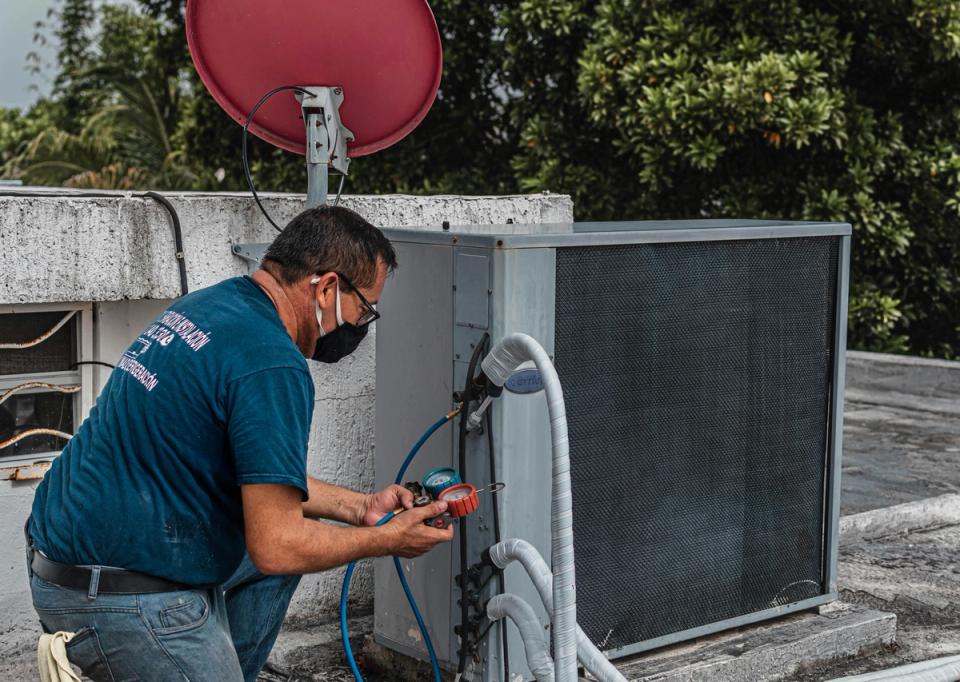
Schedule a professional AC tune-up before the first 80-degree day. A standard tune-up runs $90 to $180 and includes refrigerant level check, condenser coil cleaning, capacitor test, blower inspection, and condensate drain clearing. According to Energy Star, routine maintenance keeps a system running at near-rated efficiency, while a neglected system can lose 5% of its efficiency every year — a loss that shows up directly on your summer bills.
While you're outside, hose down the condenser fins (power off at the disconnect first) and clear at least two feet of plant material around the unit. Inside, replace the air filter. If you can't remember the last time you changed it, it's been too long.
What happens if you skip it. A blown compressor in July is the most expensive HVAC failure most homeowners will face. The compressor itself is $1,500 to $2,800 in parts plus labor; on units over 10 years old, most technicians will recommend replacement instead of repair, putting you in a $5,500 to $9,000 emergency decision in 95-degree heat. A spring tune-up catches the failing capacitor or low refrigerant charge that would have killed the compressor.
For broader cooling-season prep, our summer home maintenance checklist covers what to verify once the AC is running daily.
Safety Tasks Most Spring Home Maintenance To-Do Lists Miss
These three tasks are the most-skipped on every spring cleaning home checklist we've reviewed, and the consequences range from expensive to catastrophic.
Clean the dryer vent. Lint that escapes the lint trap collects in the duct between the dryer and the exterior wall, where it acts as kindling. The U.S. Fire Administration reports that clothes dryers cause an estimated 2,900 home fires per year, with failure to clean the vent the leading cause. Disconnect the duct, vacuum it from both ends, and check that the exterior flap opens freely. If your dryer takes more than one cycle to dry a load, your vent is already partially blocked.
Test smoke and CO detectors and replace batteries. Spring is the natural twice-a-year battery swap (the other is fall, on the daylight saving date). Hold the test button for five seconds on each unit; replace any detector older than 10 years entirely — the sensors age out even if the alarm still beeps.
Inspect deck and railings. The Consumer Product Safety Commission has documented that deck collapses are a recurring spring and summer injury cause, often from rotted ledger boards or corroded fasteners that gave way under party-load. Check that ledger bolts are tight and not rusted, that posts are firm at the base, and that no boards flex when you walk on them. A loose railing is the cheapest thing you'll fix all year and the most likely to land in a personal-injury claim if it fails.
| Safety Task | Time | What You Need | Frequency |
|---|---|---|---|
| Dryer vent cleaning | 30 min | Vacuum, flexible brush kit ($25) | Once per year minimum |
| Smoke detector test | 5 min/unit | 9V or AA batteries | Twice per year |
| CO detector test | 5 min/unit | AA batteries; replace unit at 7–10 years | Twice per year |
| Deck inspection | 30 min | Pry bar, wrench | Once per year |
| Fire extinguisher check | 5 min | Replace at expiration | Once per year |
If you want a permanent record of when you did each safety check (insurance adjusters and home buyers both ask), see our home maintenance checklist template.
Outdoor Prep, Tree Risk, and the Things That Wintered Badly
The last block of your spring home maintenance to do list is the stuff outside that took the worst beating from winter.
Inspect siding, trim, and exterior caulking. Look for paint failure at south-facing joints, gaps where wood meets masonry, and any caulk lines that have shrunk away from the substrate. Re-caulk with a good polyurethane or hybrid sealant ($8 a tube). Pest entry points multiply in spring; carpenter ants and termites are looking for soft, damp wood right now.
Service outdoor equipment. Sharpen the mower blade, change the oil, and run fresh fuel through the engine. A blade that took the winter dull will tear grass instead of cutting it, which stresses the lawn through the dry months ahead.
Check trees for storm-damaged limbs. Look for hangers (broken branches caught in the canopy), splits in major leads, and dead limbs over the house, driveway, or power drop. The USDA Forest Service and most municipal arborist guidance treat dead and hanging limbs over structures as the highest-priority tree-risk items in residential settings. A certified arborist's risk assessment costs $150 to $400. A tree on your roof costs $8,000 to $40,000 depending on what it landed on.
Flush the water heater. Sediment that accumulated all winter is sitting at the bottom of the tank, eating efficiency and shortening the unit's life. Connect a hose to the drain valve, run it to a floor drain or outside, and flush until the water runs clear. The full procedure takes 45 minutes and adds 1 to 3 years to a tank-style water heater's service life.
Exterior trim and paint touch-ups are easy to overlook but protect the wood underneath from moisture and pest entry — address peeling paint around doors and window trim while you have the caulk gun out.

For the tail of the year, our fall home maintenance checklist and winter home maintenance checklist handle the closing-down side of the cycle. To document this spring's tasks against the rest of your annual schedule, the annual home maintenance schedule template is the simplest structure we've seen.
Save Hours on Next Spring's Checklist
Real Estate Ledger keeps your spring home maintenance checklist out of a notebook and inside the planner. Every task above is pre-loaded, deep-linked, and remembers what you did last year. Mark a task done once and the app schedules the next due date automatically, files the receipt or photo against your property record, and surfaces the right vendor when it's time to call. Plans start at $1.99/month, first 30 days free, no credit card required.
Frequently Asked Questions
What should be on a spring home maintenance checklist?
A complete spring home maintenance checklist covers gutter cleaning, roof and flashing inspection, AC tune-up, foundation and grading check, sump pump test, dryer vent cleaning, exterior caulk and paint inspection, deck and railing inspection, smoke and CO detector tests, water heater flush, refrigerator coil cleaning, lawn equipment service, and a tree-risk walkthrough. Of those, the four water-shedding tasks (gutters, roof, foundation grading, sump pump) carry the highest cost-of-neglect and should be done first.
How long does spring home maintenance actually take?
A homeowner working alone on a single-family home takes 8 to 12 hours total, typically split across two weekends. The longest single tasks are gutter cleaning and the exterior caulk and paint inspection, at roughly two hours each. Hiring a pro for the AC tune-up and roof inspection cuts the homeowner's hands-on time to about 6 hours and adds $200 to $500 in service fees.
When should I start spring home maintenance?
Start as soon as overnight temperatures consistently stay above freezing — typically March in the southern United States and April through early May in northern climates. The hard deadlines are the AC tune-up (book before your first 80-degree day) and roof inspection (book before contractor schedules fill in May). Tasks that involve caulk or paint need surface temperatures above 50°F to cure properly.
How much money does a spring home maintenance checklist save?
Industry data from InterNACHI and the National Association of Home Builders puts the typical annual savings at roughly 1% of home value when seasonal maintenance is consistent — about $4,000 a year on a $400,000 home. The savings come from avoided emergency repairs (HVAC, foundation, roof leaks), longer appliance life, lower energy bills, and stronger insurance claim outcomes when documented maintenance records are presented.
Do I really need to clean the dryer vent every spring?
Yes, every spring at minimum and more often if your dryer is on a long duct run or you do more than five loads a week. Dryer fires are one of the few maintenance failures that can cause total-loss damage, and the U.S. Fire Administration consistently identifies vent blockage as the leading cause. The job takes 30 minutes and a $25 brush kit; it is the highest safety return on time of any task on this list.
References
- Insurance Institute for Business and Home Safety. "Research and Risk Mitigation." https://ibhs.org/risk-research/
- International Association of Certified Home Inspectors (InterNACHI). "Deferred Cost of Home Maintenance." https://www.nachi.org/home-maintenance.htm
- International Association of Certified Home Inspectors (InterNACHI). "Mastering Roof Inspections." https://www.nachi.org/roof-inspection.htm
- National Roofing Contractors Association. "Technical Resources." https://www.nrca.net/Technical
- National Association of Home Builders. "Housing Economics." https://www.nahb.org/news-and-economics/housing-economics
- Energy Star. "Maintenance Checklist for Heating and Cooling Systems." https://www.energystar.gov/saveathome/heating-cooling/maintenance-checklist
- U.S. Fire Administration. "Clothes Dryer Fire Safety." https://www.usfa.fema.gov/statistics/residential-fires/causes.html
- U.S. Consumer Product Safety Commission. "CPSC Warns of Outdoor Deck Collapses." https://www.cpsc.gov/Newsroom/News-Releases/2017/CPSC-Warns-Of-Outdoor-Deck-Collapses
- USDA Forest Service. "Managing Land: Urban Forests." https://www.fs.usda.gov/managing-land/urban-forests
- Insurance Information Institute. "Protect Your Home From Water Damage." https://www.iii.org/article/protect-your-home-from-water-damage
A Note on Documentation
Doing the work is half the value. The other half is having a record of it when you sell, file an insurance claim, or hand the house to the next owner. Keep dated photos of the gutters before and after cleaning, the AC service receipt, the sump pump test result, and the smoke detector battery date. A homeowner in Tampa who documented seven straight springs of roof inspections used that record to push a buyer's $4,200 roof concession down to zero during inspection negotiation. The work was the same. The paper trail was what closed the gap.
Frequently Asked Questions
What should be on a spring home maintenance checklist?
A complete spring home maintenance checklist covers gutter cleaning, roof and flashing inspection, AC tune-up, foundation and grading check, sump pump test, dryer vent cleaning, exterior caulk and paint inspection, deck and railing inspection, smoke and CO detector tests, water heater flush, refrigerator coil cleaning, lawn equipment service, and a tree-risk walkthrough. Of those, the four water-shedding tasks (gutters, roof, foundation grading, sump pump) carry the highest cost-of-neglect and should be done first.
How long does spring home maintenance actually take?
A homeowner working alone on a single-family home takes 8 to 12 hours total, typically split across two weekends. The longest single tasks are gutter cleaning and the exterior caulk and paint inspection, at roughly two hours each. Hiring a pro for the AC tune-up and roof inspection cuts the homeowner's hands-on time to about 6 hours and adds $200 to $500 in service fees.
When should I start spring home maintenance?
Start as soon as overnight temperatures consistently stay above freezing — typically March in the southern United States and April through early May in northern climates. The hard deadlines are the AC tune-up (book before your first 80-degree day) and roof inspection (book before contractor schedules fill in May). Tasks that involve caulk or paint need surface temperatures above 50°F to cure properly.
How much money does a spring home maintenance checklist save?
Industry data from InterNACHI and the National Association of Home Builders puts the typical annual savings at roughly 1% of home value when seasonal maintenance is consistent — about $4,000 a year on a $400,000 home. The savings come from avoided emergency repairs (HVAC, foundation, roof leaks), longer appliance life, lower energy bills, and stronger insurance claim outcomes when documented maintenance records are presented.
Do I really need to clean the dryer vent every spring?
Yes, every spring at minimum and more often if your dryer is on a long duct run or you do more than five loads a week. Dryer fires are one of the few maintenance failures that can cause total-loss damage, and the U.S. Fire Administration consistently identifies vent blockage as the leading cause. The job takes 30 minutes and a $25 brush kit; it is the highest safety return on time of any task on this list.
Save Hours on Next Spring's Checklist
Real Estate Ledger keeps your spring home maintenance checklist out of a notebook and inside the planner. Every task above is pre-loaded, deep-linked, and remembers what you did last year. Mark a task done once and the app schedules the next due date automatically, files the receipt or photo against your property record, and surfaces the right vendor when it's time to call. Plans start at $1.99/month, first 30 days free, no credit card required.
Get started freeRelated Checklists
Fall Home Maintenance Checklist: 12 Tasks and What It Costs to Skip Each One
A fall home maintenance checklist with sourced cost-of-neglect data for every task. Twelve jobs, dollar figures, and a free planner to track them.
9 min readSummer Home Maintenance Checklist: 12 Tasks Worth Doing Before August
A summer home maintenance checklist with 12 dated tasks, sourced cost-of-neglect data, and one-click planner deep-links. Free printable version included.
11 min readWinter Home Maintenance Checklist: 12 Tasks (and What Skipping Each One Actually Costs)
Winter home maintenance checklist with sourced cost-of-neglect data for each task. 12 jobs, repair price ranges, and a free planner you can save to your home.
9 min readHome Maintenance History Report: Complete Checklist for Homeowners
Build a home maintenance history report that tracks every repair and service call. Use our checklist to document your house maintenance history.
5 min read